 |
|
| You are here: Index > Surveys of Secondary Worlds > A Princess of Mars (1912) | |
Reviewing A Princess of Mars (1912)[written on 02-27-2026]I've neglected to review any pulp fiction, but over the past year I've found myself reading a lot of it. I started with the Conan stories by Robert E. Howard and from there I quickly fell in love with this adventurous mode of storytelling. The prose is epic, the settings are fantastical, and the encounters are described in such excited detail that life and death truly feel at stake. Aside from Conan I've also read a good deal of H.P. Lovecraft's work, as well as other miscellaneous stories such as Edmond Hamilton's Dreamer's Worlds. They've all been true fantasy; even in the case of Lovecraft they err on the side of concepts and creatures beyond the realms of scientific thought, and in that exploration comes a lot of their enchantment. Edgar Burroughs' A Princess of Mars is an exception to the pulp I've read because it's explicitly science fiction. Very early science fiction, mind you — our modern technology would astonish the scientists of 1912 — but still sci-fi nonetheless. That, combined with the wild adventuring and brutality of pulp, utterly enchanted me, enough that I daresay it's my favorite pulp yet. I can easily recommend it without a full review, though I will go on anyway because the world of Barsoom and the adventures within are worthy of explicit praise. 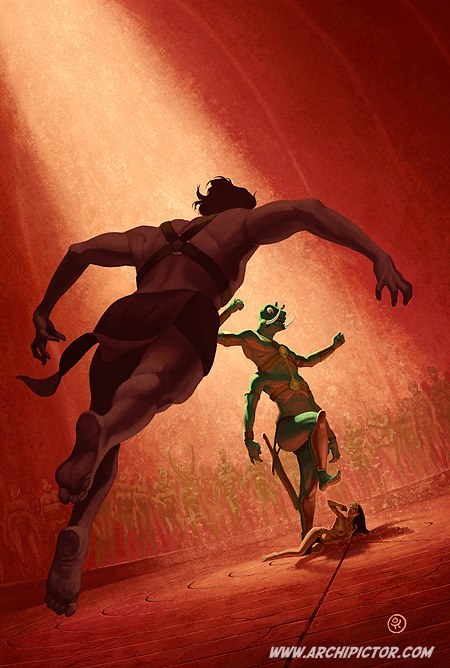
Personal Scorethis criteria uses the DecentFilms rating formula.Letter-Grade Recommendability: A+ Princess of Mars has an excellent start. John Carter is a youthful protagonist, driven by deep emotion, and he has a strong initiative. We see this demonstrated in the wild lands of Reconstruction-era Arizona, which cleverly warms us up for the coming experience by introducing similar elements; savage indian tribes, hot red landscape, and John Carter's solo ambition in the face of danger. By the time he's spirited away to Mars, known to its inhabitants as Barsoom, the reader has already been primed for what manner of man and story he will follow. Barsoom itself is an enchanting setting, taking advantage of the familiar appearance of Mars and enriching it with history. There are dried-up seas that are now crossable, a factory that manufactures the planet's atmosphere, and green martian tribes camp in the ruins of a pale-skinned civilization. As strange as the land is already, with its yellow mossy surface and giant green men, Burroughs is eager to write about a world lost to time as well as the state its inheritors have left it. John Carter, stuck in the same boat as us, serves to enlighten us both, his eagerness to learn more about where he has been isekai'd allowing the same questions to be posed that we have and thus reason to record the answers (the book is passing as if Carter wrote it himself). While a story of John Carter playing at Lewis & Clark on Mars would likely be interesting in its own right, his motivation quickly develops as he entwines himself with many other characters. The most important of these, clearly, is Dejah Thoris; Princess of Helium, she is portrayed through her beautiful figure and noble tongue as being utterly desirable, and John Carter's swift infatuation with her is understandable. The two form a romance that is very sweet, a chemistry of the untamed but naive masculine and the highborn but emotional feminine tempered in heartfelt affection. Other notable individuals include the green martian Tars Tarkas, a chieftain who slowly becomes a good friend and gentle warlord, and Sola, another green martian raised with a compassion foreign to the others of her kind. Through virtue of kindness and honor, always checked by a willingness to spill blood, John Carter quickly gains the respect and affection of those around him; his Earthly origin not only giving him unnatural power on Mars gravity, but also a fresh perspective on the racial feuds of the planet. 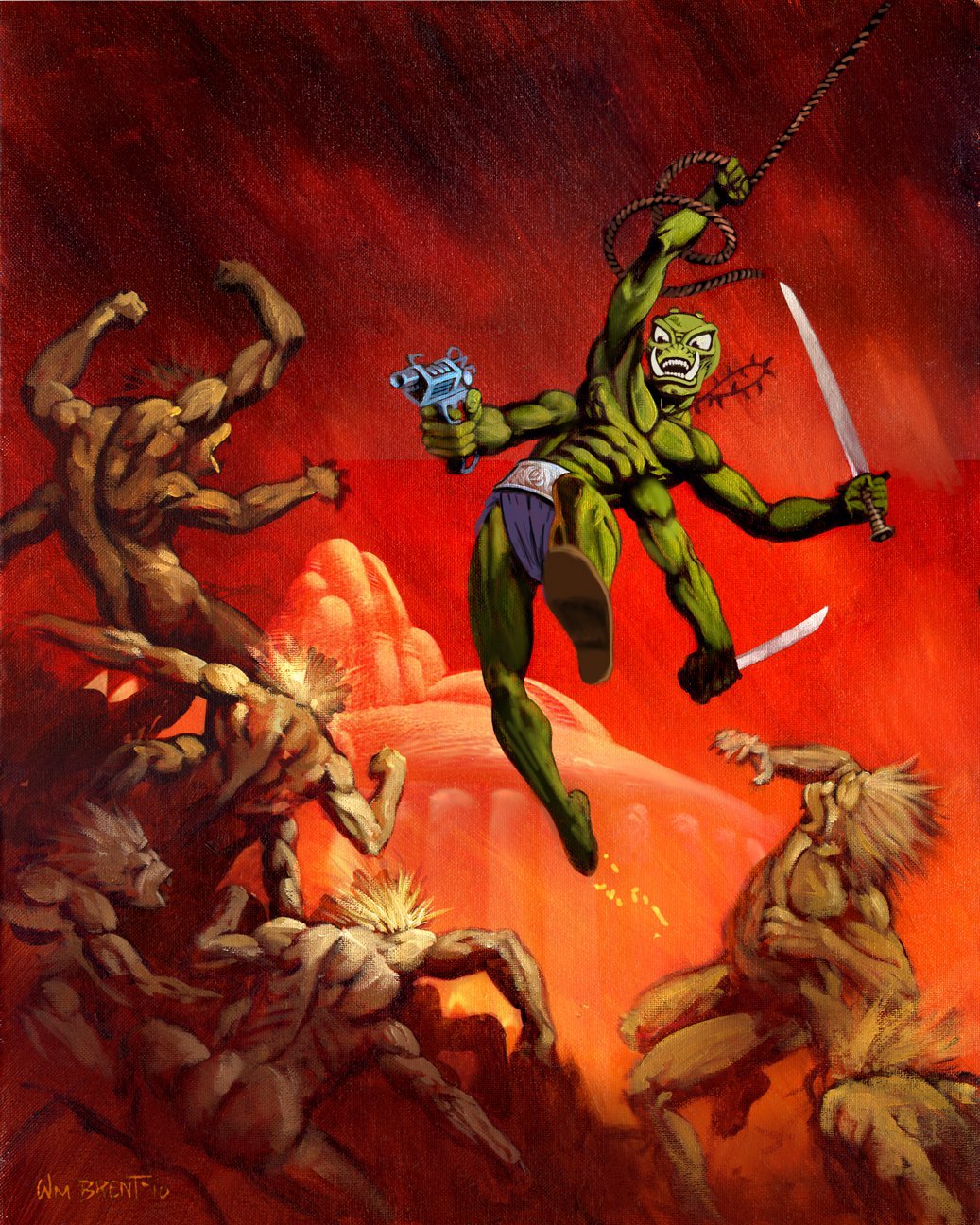 The green martians act, as mentioned before, in a similar manner to the American Indian. They're nomadic, primitive, and gain tribal rank through mortal combat. They also delight in inflicting pain on others; we see this most notably with the Warhoons, who ornament themselves with the severed appendages of their foes and subject their prisoners to deadly games. Despite their savagery the book does elaborate on their capacity for good; Dejah Thoris believes peace can be found between the green and red men of Mars, and John Carter ultimately proves it through his befriending and allying with Tars Tarkas. This is something I've always noted about the traditional treatment of the savage; subhuman in behavior, yes, but not irredeemable. It's a theme that I can definitely get behind, especially as seeing the Tharks overcome their nature and come together for a grander purpose is very satisfying to read. When Princess of Mars comes to a close, it's back in Arizona, leaving both John Carter and the reader longing for more. And more Burroughs did deliver, writing many more stories set in Barsoom before his death. I intend to read all of them, thanks to my Mother gifting me a collection of the tales. I know I'll enjoy them, too, because with its traditional virtues and old-fashioned approach to sci-fi I know I'll be in for a good time when I'm transported back to Barsoom with a certain former Confederate officer. |
|
Exodite.org | 2023-2026





|
|